May 12, 2026

Pipe network heptafluoropropane fire extinguishing system is one of the most widely used and technically mature forms in the field of gas fire extinguishing. Unlike cabinet devices, the pipe network system stores the fire extinguishing agent bottle group in a special cylinder room, and transports the agent to the protective area for spraying through the pipe network. This design makes it particularly suitable for large data centers, new buildings with multiple protection zones, and places where aesthetics are highly demanding. This article will take the pipe network heptafluoropropane fire extinguishing system as an example, analyze its complete workflow from fire detection to fire extinguishing completion in detail, and introduce the professional products and services of Guangdong Dingya Fire Equipment Co., Ltd. in this field.
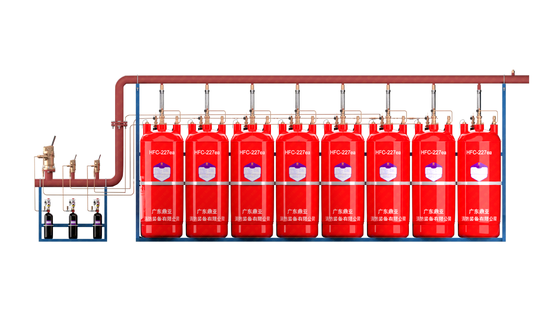
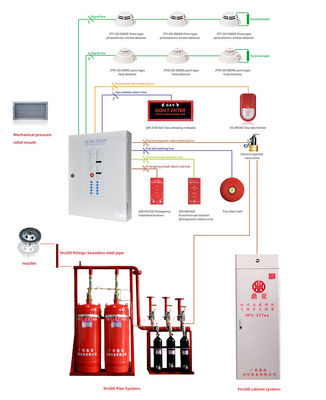
The pipe network type heptafluoropropane fire extinguishing system consists of two parts: automatic fire alarm and fire extinguishing control system and fire extinguishing agent storage and transportation system.
The automatic fire alarm and fire extinguishing control system includes automatic fire alarm controller, gas fire extinguishing controller, smoke detector, temperature detector, sound and light alarm, emergency start-stop button, manual automatic transfer switch, spray display door light and other equipment.
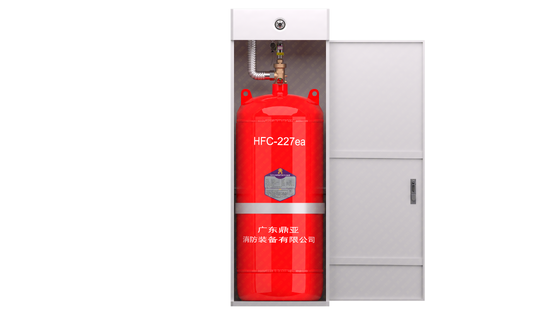
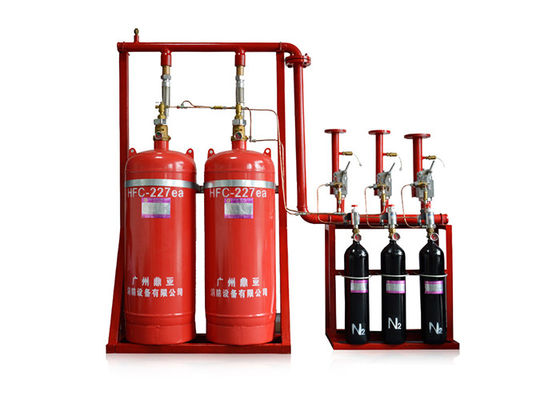
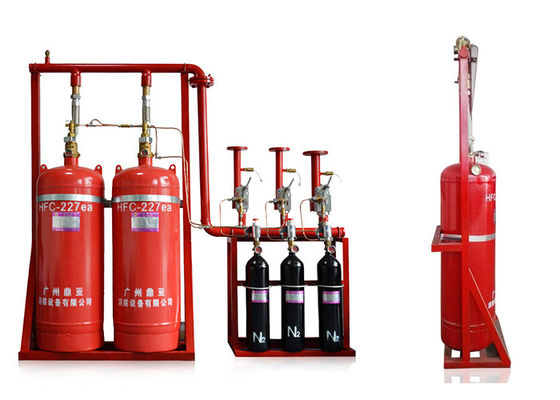
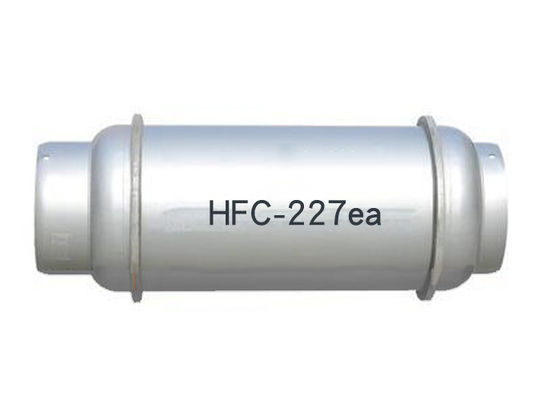
The fire extinguishing agent storage and conveying system is mainly composed of fire extinguishing agent storage bottle group, starting bottle group, selection valve, pipe network, nozzle, pressure signal feedback device and various connecting pipelines. The fire extinguishing agent storage bottle set stores the heptafluoropropane fire extinguishing agent, the starting bottle group stores nitrogen for driving the container valve and the selection valve, the pipe network transports the fire extinguishing agent from the cylinder to the protective area, and the nozzle is responsible for spraying the fire extinguishing agent evenly to the entire protective space.
According to different conveying methods, the pipe network system can be divided into two types: internal pressure storage type and external pressure storage type. The internal storage pressure type uses nitrogen as the driving gas, which is stored in the same cylinder with the fire extinguishing agent, and the conveying distance is generally not more than 60 meters. The external pressure storage type adopts an independent drive gas cylinder group to push the fire extinguishing agent through high-pressure nitrogen, and the transportation distance can reach more than 200 meters, which is suitable for large buildings or projects with complex pipelines.
The working principle of the pipe network type heptafluoropropane fire extinguishing system can be summarized as follows: when a fire occurs in the protected area, the fire detector transmits the signal to the controller, and the controller confirms the fire and issues a linkage command to turn off the ventilation and air conditioning, fire valve and non-fire power supply in the protected area. After the set delay time, the controller issues a start command to open the start bottle group. The starting bottle set releases nitrogen gas, and the container valve of the fire extinguishing agent storage bottle group is driven to open in turn. The fire extinguishing agent enters the laid pipe network through the selection valve and sprays it into the protective area through the nozzle to achieve the purpose of fire extinguishing. After the fire extinguishing agent is sprayed, the pressure signal feedback device transmits the signal back to the controller and lights up the bleeding indicator light outside the protection area.
The grid-type heptafluoropropane fire extinguishing system is designed with three starting methods to ensure reliable fire extinguishing in any situation.
The automatic control method is suitable for use when the protected area is unattended. After the control mode transfer switch on the fire extinguishing control panel is dialed to the "Auto" position, the system is in the automatic control state. When a fire occurs in the protected area, two independent types of fire detectors (usually smoke and temperature) emit a fire signal at the same time, the controller confirms the fire occurrence, issues an audible and visual alarm and starts the linkage device, and after a 30-second delay, issues a fire extinguishing command, starts the action of the bottle group, and drives the release of the fire extinguishing agent.
The electrical manual control method is suitable for use when the protected area is manned or on duty. After the control mode transfer switch is diverted to the "manual" position, when a fire occurs, the personnel can press the manual control box outside the door of the protected area or the start button on the controller, and the system will start the fire extinguishing according to the predetermined program (there is also a 30-second delay). Even in the automatic state, manual control can be prioritized.
The mechanical emergency manual control method is suitable for power failure or automatic detection and control system failure. After confirming that a fire has occurred and ensuring that all personnel have been evacuated, the operator can enter the cylinder room and directly operate the mechanical emergency start device on the starting bottle set, or directly operate the container valve on the fire extinguishing agent storage bottle group and manually open the valve to release the fire extinguishing agent. For systems with selector valves, the selector valve of the corresponding protection area needs to be opened manually before opening the container valve.
In addition, the system has an emergency stop function. In the delay stage, if it is found that there is no need to start extinguishing due to false alarm or change in circumstances, the emergency stop button can be pressed to stop the issuance of fire extinguishing instructions.
When a fire breaks out in the protected area, the smoke detector first senses the smoke particles and transmits the signal to the fire alarm controller. At this time, the controller sends out an early warning signal, and the sound and light alarm in the protected area is activated, reminding the personnel to pay attention. However, at this time, the fire extinguishing program has not yet started, and the system is on alert.
When the temperature detector in the same protection area also senses the temperature abnormality and emits a fire signal, the two independent detectors confirm the existence of the fire at the same time. The controller confirms the fire occurrence according to the preset logic and immediately enters the fire extinguishing program.
The controller first issues a linkage command to perform the following operations through the control module: turn off the ventilation and air conditioning system of the protected area to prevent the loss of fire extinguishing agent; Close the fire valve and cut off the air circulation; cut off non-fire power sources unrelated to fire protection to avoid secondary hazards caused by electrical equipment in the process of fire extinguishing; Close doors and windows (e.g. automatic closing devices) to ensure that the protected area forms an enclosed space. The purpose of this series of actions is to ensure that the protected area has the conditions for full submerged fire extinguishing, so that the fire extinguishing agent can effectively maintain the fire extinguishing concentration.
At the same time, the controller enters the 30-second delay phase. During the delay time, the sound and light alarm continued to sound, prompting the personnel in the protected area to evacuate quickly. According to the GB50370 "Design Code for Gas Fire Extinguishing Systems", the delay time can be adjusted between 0 and 30 seconds according to the actual situation of the protected area, usually set to 30 seconds. The design of the delay stage fully reflects the safety concept of "people-oriented" and provides the necessary time for the safe evacuation of personnel.
After the delay ends, the controller sends a DC24V start signal to the electromagnetic drive on the starting bottle set. The electromagnetic drive action punctures the diaphragm on the starter bottle group, and the high-pressure nitrogen stored in the starter bottle group is quickly released. The released nitrogen is divided into two ways: one is driven by the selection valve of the corresponding protection area through the air control pipeline, and the other is driven to open the container valve on the fire extinguishing agent storage bottle group.
After the selection valve is opened, the fire extinguishing agent delivery channel is connected. After the container valve is opened, the heptafluoropropane fire extinguishing agent in the fire extinguishing agent storage bottle group enters the collection pipe under its own pressure (internal storage pressure type) or is pushed by the driving gas (external pressure storage type), and flows into the pipe network system of the corresponding protection area through the open selection valve. The fire extinguishing agent is transported to the protective area through the laid pipe network, and is evenly sprayed to the entire space through the nozzle. The entire spraying process is completed within 10 seconds, and the extinguishing agent quickly reaches the design extinguishing concentration to achieve full submersion extinguishing.
When the fire extinguishing agent is sprayed, the pressure signal feedback device installed in the collection pipe or pipe network acts to transmit the spray signal to the fire extinguishing controller. The controller immediately lights up the "degassing indicator" outside the protection area, reminding the personnel that the fire extinguishing agent has been released in the protection area and is prohibited from entering. At this point, the fire extinguishing process is completed.
When personnel find a fire, they can manually start the system as follows: first confirm that all personnel in the protected area have been evacuated, close the doors, windows and ventilation equipment in the protected area, and then press the emergency start button on the manual control box outside the door of the protected area. If the system is set to 0 delay, the spraying will be started directly.
When both automatic and manual controls fail (such as power failure, controller failure), mechanical emergency operation is required. The operation steps are as follows: first confirm that there is no person in the protection area, then enter the cylinder room, find the selection valve of the corresponding protection area, manually pull the mechanical handle of the selection valve to the opening position, then find the starting bottle group, remove the safety pin on the electromagnetic starter, press the manual button on the electromagnetic starter forcefully, start the bottle group to release nitrogen, and drive the system to spray and extinguish the fire. If the mechanical start of the starting bottle group also fails, you can directly operate the mechanical emergency start handle of the container valve on the fire extinguishing agent storage bottle group in the corresponding protection area, and manually open the container valve to release the fire extinguishing agent.
After operation, the spraying situation should be confirmed, which can be judged by hearing (hearing the spraying sound) or observing the change of the pressure gauge. For systems with multiple extinguishing agent storage bottle sets, ensure that all bottle sets are open.
After the fire extinguishing is completed, the following safety matters should be noted: It is strictly forbidden to enter the protected area immediately, and it must be fully ventilated before entering. If you need to enter early, you must wear an air respirator. Avoid contact with spray lines and nozzles, as they can cause frostbite due to extremely low temperatures during spraying. After entering the protected area, care should be taken to prevent slipping, as condensation may form on the ground after the fire extinguishing agent is sprayed.
System recovery should be carried out according to the following steps: first open the doors and windows of the protected area or start the mechanical exhaust system, thoroughly ventilate and ventilate, and the number of air changes should not be less than 5 times per hour. Then check the cause of the fire and rule it out. Subsequently, the system was reset by professionals, including replacing the activated solenoid starter diaphragm and the starting bottle group diaphragm, closing the open selection valve and container valve, refilling the sprayed fire extinguishing agent storage bottle set, checking the tightness of each connection, and conducting an air tightness test to confirm that there was no leakage. Finally, the system linkage test is carried out to confirm that all equipment has returned to normal and put back into standby state.
Guangdong Dingya Fire Equipment Co., Ltd., headquartered in Nansha District, Guangzhou, is a comprehensive enterprise integrating the production, sales, R&D, construction, maintenance and training of fire protection equipment, focusing on the research and development and manufacturing of heptafluoropropane fire extinguishing systems. The pipe network heptafluoropropane fire extinguishing system produced by the company strictly follows the national standards such as the GB50370 "Design Code for Gas Fire Extinguishing Systems" and the GB25972-2024 "Gas Fire Extinguishing System and Components", and the products have passed the testing of the National Quality Supervision and Inspection Center for Fixed Fire Extinguishing Systems and Refractory Components, and have obtained ISO9001 quality management system certification, ISO14001 environmental management system certification and CE certification.
Dingya Fire Protection's pipe network heptafluoropropane fire extinguishing system has the following core advantages: complete product line, covering internal pressure storage type (4.2MPa/5.6MPa) and external storage pressure type, which can be flexibly selected according to the actual needs of the project; It can protect up to 8 protection zones, greatly reducing equipment investment costs through a combined distribution system. The external pressure storage system can have a conveying distance of more than 200 meters, which is suitable for large data centers, airports, museums and other ultra-large or complex pipeline scenarios; The company has 20 senior engineers and 13 R&D and design personnel, which can provide one-stop services from scheme design, equipment production to construction and installation, commissioning and maintenance to ensure the reliable operation of the system throughout the life cycle.
Dingya Fire Protection's pipe network heptafluoropropane fire extinguishing system has been widely used in data centers, communication rooms, power distribution rooms, archives, museums, chemical sites, production workshops, commercial centers, airports and other important places. The company always adheres to the business philosophy of "high-quality products, perfect service, and reasonable price", and builds a solid safety defense line for customers with the enterprise spirit of "hard work, innovation, harmony and development".
Guangdong Dingya fire pipe network heptafluoropropane fire extinguishing device
The pipe network heptafluoropropane fire extinguishing system realizes reliable fire protection for large and multi-protection areas through scientific system design, reliable equipment configuration and complete control logic. Its core operation logic can be summarized as follows: two detectors confirm the fire, link to shut off the equipment, delay the evacuation of personnel, start the bottle group drive selection valve and container valve, the fire extinguishing agent is sprayed through the pipe network, and the signal feedback completes the fire extinguishing. The three start-up methods are mutually reserve to ensure reliable operation in any situation.
When choosing a pipe network type heptafluoropropane fire extinguishing system, priority should be given to professional manufacturers with complete qualifications, strong technical strength and perfect service system. With its professional technical team, complete product certification, and one-stop service capabilities, Guangdong Dingya Fire Equipment Co., Ltd. has become a trusted partner in this field.